
This blog post was written by Iliana Delgado, rising 2L at Georgetown University and Summer Legal Intern at National Network for Youth.
On April 28, the Department of Housing and Urban Development (HUD) posted a proposed regulation change to its Equal Access Rule. The proposed changes have serious negative implications for LGBTQ+ youth who need access to housing and services.
When a federal agency wants to change their regulations, they must solicit public input. NN4Y highly encourages concerned individuals and organizations to submit a comment by Monday, June 29, 2026.
What is the Equal Access Rule?
The Equal Access Rule (EAR) was created in 2012 to ensure equal access to the Department of Housing and Urban Development’s (HUD) housing programs regardless of one’s sexual orientation, gender identity, or marital status. It was updated in 2016 to expand these protections to include transgender and gender non-conforming individuals.
Under HUD’s Equal Access Rule, programs, shelters, and facilities funded by HUD’s Community Planning and Development (CPD) programs must provide equal access to services and accommodations based on a person’s gender identity. Individuals experiencing homelessness must be placed in shelters and shared living spaces that align with their gender identity and cannot be required to answer invasive questions or provide medical documentation to verify their gender identity. These protections help ensure that transgender and gender non-conforming people can safely access shelter and homelessness services without discrimination.
What would the proposed regulation change do?
The proposed change to the Equal Access Rule would:
- Remove all references to “gender,” “gender identity,” and “sexual orientation” and replace them with “sex,” as defined by the Trump Administration’s Executive Order 14168 entitled “Defending Women from Gender Ideology Extremism and Restoring Biological Truth to the Federal Government.”
- This change would eliminate the current federal protections for LGBTQ+ individuals’ access to shelters and other HUD programs in a way that aligns with their gender, gender identity, or sexual orientation, including Section 8 housing, fair housing enforcement, homelessness and domestic violence programs, and community development programs.
- Remove protections that prohibit shelters and other programs that permit single-sex or sex-specific facilities from inquiring about the gender identity or sexual orientation of those they serve.
- The current rule allows facilities to maintain sex-specific spaces like separate sleeping quarters, but prohibits them from using gender identity as a basis for denying access entirely. The proposed changes would remove these protections, permitting facilities to confirm the sex of individuals seeking service and deny service to those whose gender identity or expression does not match the sex category the facility determines them to be.
- Allow providers to require “reasonable assurances or evidence to establish a person’s sex”, opening the door to potential harassment, abuse, and re-traumatization for transgender and gender non-conforming individuals.
- Override state and local non-discrimination laws that offer broader protections for LGBTQ+ individuals. This means that even in states or localities where additional protections for LGBTQ+ individuals exist, HUD-funded providers would be governed by the federal regulation, potentially overriding the better state and local protections.
Under the proposed rule, noncompliance with HUD’s new requirements could result in the loss of federal funding and other applicable penalties, although some ambiguity remains since HUD has not specified what enforcement would look like. HUD does state that it intends to give “maximum deference to the grantees” and “recognizes that some grantees may be more flexible or stringent in their policies than others in providing evidence of a person’s sex.” However, because the rule removes the current legal prohibition on sex inquiries, providers in protective states who continue serving individuals in a way that is consistent with their gender identity could still face tension with the federal standard.
This proposed rule does not automatically deny all LGBTQ+ individuals access to all shelters, but rather removes the federal protections that currently prohibit discrimination based on gender, gender identity, and sexual orientation. This may leave vulnerable people, particularly transgender and gender-nonconforming individuals, with significantly less recourse when discrimination occurs.
What can I do?
Anyone, from organizations to individuals, can submit a comment. Submit a unique (do not just copy and paste and submit) public comment here urging HUD to withdraw the proposed rule. Comments are due by June 29th at 11:59pm ET. Use this comment template to draft your individual comment. Avoid copying and pasting the template word-for-word; the more unique and personalized a comment, the more persuasive and helpful it is!
To submit a comment, click this link, then click the blue “Comment” button under the rule title.
We are looking to collect stories of how accessing safe and affirming housing helped you or others exit homelessness. We are partnering with Lambda Legal to use these stories to inform and potentially share in our organizations’ comments.
Your feedback as an LGBTQ+ youth with experience of homelessness and/or a youth homelessness service provider is invaluable to combatting these harmful changes. Please complete our short survey to share your experiences and perspective on how accessing safe and affirming housing helped you or others exit homelessness.
Learn More
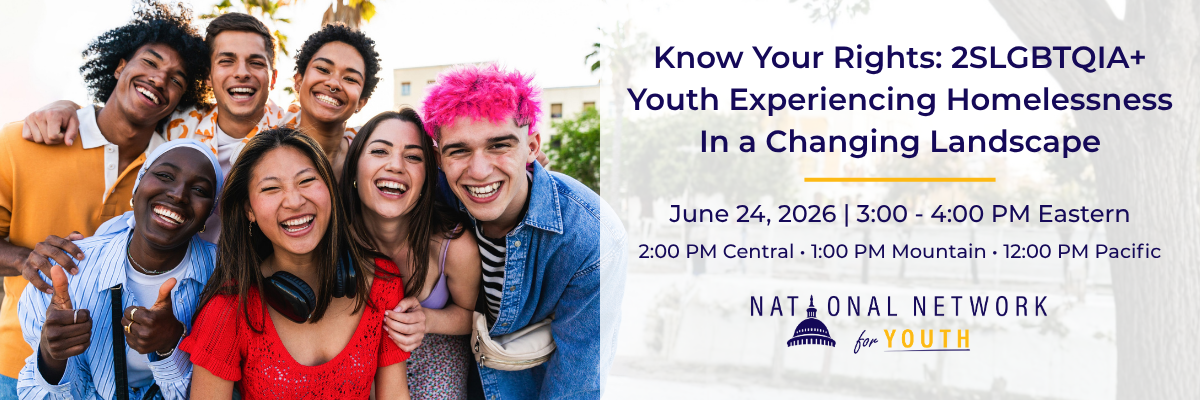
Date Wednesday, June 24, 2026
Time 3:00 – 4:00 PM Eastern (2:00 PM Central, 1:00 PM Mountain, 12:00 PM Pacific)
Join a webinar led by members of NN4Y’s National Youth Advisory Council (NYAC), young people with lived expertise of homelessness who helped create NN4Y’s Know Your Rights Toolkit.
In this session, NYAC members will walk through what 2SLGBTQIA+ young people experiencing homelessness need to know about their rights related to housing, healthcare, education, workplace protections, privacy, vital documents, and safety — and what protections remain in place even amid today’s rapidly shifting policy landscape. Whether you’re a young person navigating these systems, a youth worker, or a community member who wants to show up for 2SLGBTQIA+ youth, this session will leave you with clear, practical information and trusted resources drawn directly from the toolkit.

