
On July 24, the President signed an executive order (EO), Ending Crime And Disorder On America’s Streets. This executive order, in conjunction with the Supreme Court’s decision, Johnson v. Grants Pass, further criminalizes homelessness.
This executive order is deeply upsetting and out of line with evidence-based, humane ways to support those who are unsheltered and in crisis.
- Directs the Attorney General (AG) and federal agencies to encourage states and localities to commit or incarcerate unsheltered individuals who are using substances or who have severe mental health challenges.
- Directs the AG to ensure that incarceration and involuntary institutionalization are legal, available options for communities to keep individuals off the streets.
- Directs the AG, U.S. Department of Health and Human Services (HHS), the U.S. Department of Housing and Urban Development (HUD), and the U.S. Department of Transportation to prioritize grant funding for communities that keep individuals off the streets, including by prohibiting loitering and encampments.
- Directs HUD to end support for policies such as housing first and harm reduction.
- Directs HUD to require grantees to share data with law enforcement.
The EO’s new priorities will likely be reflected in upcoming Notices of Funding Opportunity. Grant guidelines will likely prohibit the use of grant funds for housing first models and harm reduction strategies, instead requiring conditioning homeless assistance on treatment compliance rather than voluntary engagement. Furthermore, funding priorities may shift to jurisdictions that count few unsheltered individuals, potentially incentivizing artificially low Point-In-Time (PIT) counts to qualify for funding.
Further impacts of this EO will depend on how states and local communities choose to carry it out. Local officials will decide whether to clear encampments, ban loitering, arrest people, or commit them to treatment through local laws or rules.
Service providers should keep a close watch on changes in their area so they know about any new enforcement actions, laws, or requirements from state or federal agencies.
No. EOs can influence federal policy and direct federal agencies to modify their practices, but cannot override or contradict current laws. While many of the provisions in this executive order may be unconstitutional and challenged in federal court, it still has the potential to shift funding priorities and change enforcement policies.
Read more about executive orders and their limitations here.
Learn More in an Upcoming Webinar!
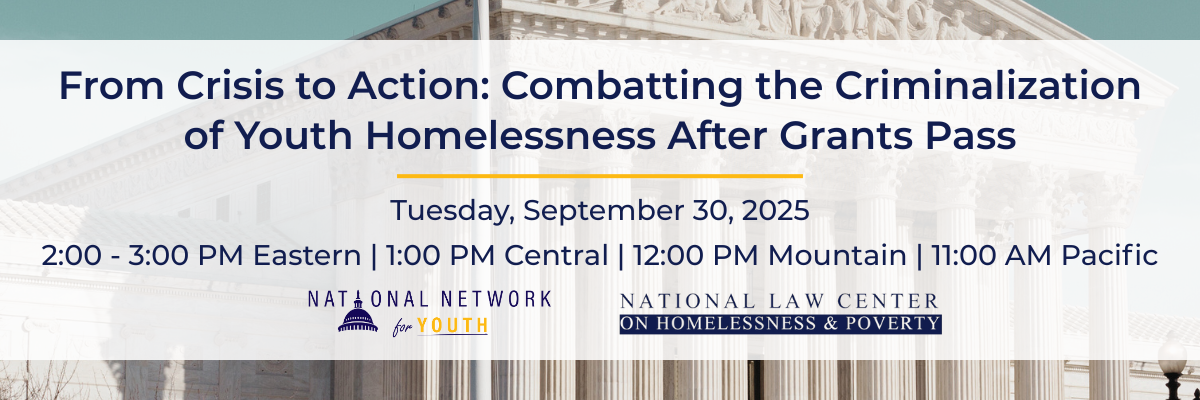
Date Tuesday, September 30, 2025
Time 2:00 – 3:00 PM Eastern (1:00 PM Central, 12:00 PM Mountain, 11:00 AM Pacific)
In the wake of the U.S. Supreme Court’s decision in City of Grants Pass v. Johnson, communities across the country have seen or are bracing for a surge in the criminalization of visible homelessness. For youth and young families experiencing homelessness—particularly those forced to sleep outdoors—this ruling is a direct threat to their safety, well-being, and civil rights.
Join the National Network for Youth (NN4Y) and the National Homelessness Law Center (NHLC) for a critical webinar focused on equipping youth service providers, advocates, and local leaders with immediate and long-term strategies to protect all people experiencing homelessness, including young people from criminalization, advocate for humane policies, and ensure access to housing and services.
This session will unpack the legal implications of Grants Pass, highlight on-the-ground impacts for youth, and share concrete tools for advocacy, programmatic response, and local systems change. It will also feature two youth homelessness providers who are leading local and state-level responses to proposed anti-homelessness legislation.
This webinar is hosted with the National Homelessness Law Center.

